


Every Case Accounted For: Litigation Management

A group-wide register of every live case, kept up to date by the lawyers running them — the basis for your provisions, your year-end audit and the decisions in between.

Litigation provisions are a legal judgement before they're an accounting entry. They're the sum of a lot of individual assessments made by the lawyers running each case: how likely is the claim to succeed, how much would it cost, and what's changed since the last reporting date? In most companies, the basis for those numbers is a spreadsheet and a round of emails that goes out to every entity and every country before each quarter-end. Replies come back late or half-complete, cases nobody logged stay invisible, and mistakes creep in when it's all consolidated by hand. You end up making decisions on approximate data — and, at worst, fielding questions from the auditor that take weeks to answer.

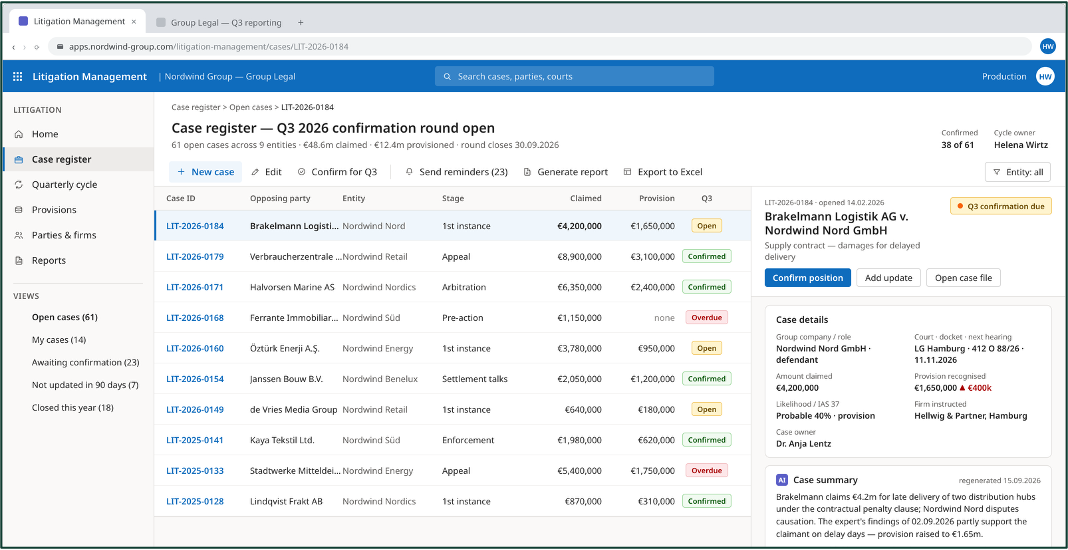
Litigation Reporting replaces the spreadsheet and the email round with a single register that the responsible lawyers maintain themselves. Each case logged contains the key details, captured at the outset: the group companies involved and their role, the opposing party, the court or tribunal, the amount claimed, the provision required, the stage the case has reached, the firms instructed, and the in-house lawyer who owns it. Every update carries a date and a name, whether that's a hearing date, a revised figure or a judgment uploaded to the file.

Before each quarter-end, the application runs the reporting round itself: it asks the case owners across every entity, country and business unit to confirm or update their cases, chases them automatically, and shows group legal who hasn't replied yet. When the round closes, the report is generated — open cases, movements since last quarter, amounts claimed and provisions by entity. A Power BI dashboard shows the same picture live between reporting dates.

Beckman CoulterThe logo of StihlFintelTHe logo of EnBWHellmann Worldwide LogisticsVaillant Group

Key Benefits

  • One group-wide register of every case, kept by the people who actually run them
  • The same fields and the same status values across every entity in the group
  • View amounts claimed and provisions both per case and in total — defensible for finance and the auditor at any point in the quarter, not just at quarter-end
  • Every update dated and attributed
  • The quarterly report generated straight from the register, with automatic reminders and visible response rates by entity
  • A Power BI dashboard for management: the portfolio, how provisions are moving, and any cases not recently updated
See Litigation Reporting in Action
Book a Demo

We'd be glad to walk you through how Litigation Reporting would handle your own portfolio — from a single case through to a finished quarterly report. Book a demo now, or leave your details and we'll get back to you shortly.

Thank you!
We'll reach out to you with further information
Oops! Something went wrong while submitting the form.

Our Litigation Reporting Application in Detail:

From a Single Case to the Quarterly Report

What sits in the register becomes binding in two places. Where a claim is likely to succeed, a provision has to be recognised and re-measured at every reporting date — under IAS 37 and its equivalents in local GAAP; where it isn't, a disclosure in the notes may still be required. And for the material cases, the auditor wants the legal department's own assessment, often alongside that of the firm instructed. A register with dated entries against each case is what both of those rest on.

The quarterly cycle replaces the email round. When it opens, each case owner sees their own cases and confirms or updates them by a set date. Reminders go out on their own, and group legal can watch the response rate entity by entity. Closing the cycle produces the report in whatever form you've agreed, and the register keeps a log of who confirmed which position, and when.

Who sees which cases follows your own structure: an entity sees its own, group legal sees everything, finance sees the numbers. So does the scope. A more lightweight version is a register with a quarterly confirmation and a generated report — enough on its own to retire the spreadsheet and the email round. The more extensive version is a running case history, where each development is recorded as it happens and the dashboard is current on any given day rather than once a quarter. Most clients start with the first and grow into the second.

Dashboard and AI Case Summaries

The dashboard automatically provides meaningful insights across all open claims: how many there are and what they're worth, entity by entity; the stage each has reached; the type of opposing party and the firms acting; how provisions have moved across the last few quarters; what's been opened and closed, and how long cases typically run; and any cases not recently updated. It answers the questions a spreadsheet never could — which entity is generating the disputes, which opponents keep coming back, how long a case really takes, and where the provisions are drifting.

Additionally, an optional AI layer keeps a current plain-English summary against each case: what it's about, where it stands, and what's happened since the last report. It's assembled from the structured data, the history of updates and the documents held against the case. Processing runs inside your own Microsoft tenant, so none of the case data leaves it.

Project Approach and Pricing

Litigation Reporting runs on the Power Platform, part of your existing Microsoft 365 subscription: the register in SharePoint or Dataverse, capture and updating in Power Apps, the quarterly cycle in Power Automate, the dashboard in Power BI. There's no new software product to buy, and with it no procurement round and no security review for another cloud service — your case data stays in your tenant, and access follows the identity management you already run. If you're already on BRYTER or HighQ, we'll build the same solution there instead.

We'll start with your existing list and latest quarter-end report: what you record against each case, which of those details finance and the auditor actually need, and where the round gets stuck now. Fields, case stages and the shape of the report get set together with legal and finance. We then move your live cases into the register, stay alongside you through the first cycle in the tool, and either hand over to your team or take on long-term support.

  • One-off: from £15,000 / €18,000 / $21,000 implementation fee, including the full build by NodeMasters' automation consultants and no additional licence fees
  • Ongoing costs: your existing Microsoft 365 licence. Depending on your agreement, individual features may need an upgrade — Power Apps or Power Automate Premium where Dataverse is involved, and Power BI Pro for whoever receives the dashboard. The AI summaries bill by consumption. We'll establish all of it with you before the project starts; in practice it's a small figure next to the reporting effort it replaces
  • Fields, case stages, the report format and the deadlines in the quarterly cycle are all built for your own team to maintain. We only bill for structural changes, and only for the time they take
Three NodeMasters co-founders (Thom, Steffen & Wolfgang) stood in a line in front of an exposed concrete background, dressed in sweaters and white shirts, smiling at the camera.

Tell us your bottleneck…

NodeMasters is the on-demand legal tech consultancy that fits around how your team already works.
Whether you're looking at AI & automation for the first time or need expert support with your existing technologies, we can help.